
SYSTEMIC
An integrated approach to the challenge of sustainable food systems: adaptive and mitigatory strategies to address climate change and malnutrition
Background and aim
The SYSTEMIC network brought together scientists from various disciplines to collaboratively explore solutions, identify knowledge gaps, and develop strategies for transforming food systems. Although there is abundant information on improving productivity and sustainability in individual agricultural sectors, comprehensive, cross-sectoral approaches to sustainable food and agriculture remain scarce in the literature. SYSTEMIC sought to bridge this gap by developing proven strategies for creating a sustainable, resilient, and nutritious food supply that integrates both land and sea resources. Researchers from eight European countries Belgium, France, Germany, Italy, Latvia, Norway, Portugal, and Spain collaborated to build a network that enhances understanding of food and nutrition security in a changing environment. This collaboration emphasized knowledge and technology sharing, with national and transnational R&D projects playing a key role. The project was organized into interrelated work packages covering resource use, production, consumer preferences, nutrition, and public health. Additionally, case studies were developed to address the complexities involved in transforming food systems.
The goal of SYSTEMIC was to develop a unified vision for an integrated food system that promotes sustainability across production, consumption, and public health. By aligning with key Sustainable Development Goals specifically (2) zero hunger, (3) good health and well-being, (12) responsible consumption and production, (13) climate action, and (17) partnerships for the goals SYSTEMIC aimed to contribute significantly toward the creation of a sustainable and equitable global food system.
Key results
- Tools for assessing dietary intake: Are diet-tracking mobile apps suitable to estimate energy and macronutrient intake? Comparing the data obtained from the five apps available in Italy with those from the dietary software “Foodsoft 1.0” used in the last national food consumption survey, no significant differences were found in the mean values of energy and macronutrients, except for fat intakes. The selected apps could be a suitable tool for assessing dietary intake, as well as Foodsoft 1.0, and reduce the interview burden.
- Global Durum Panel: The Global Durum Panel (GDP) is a representative, broad and diverse collection made of 10.11 tetraploid wheat accessions consisting of durum wheat modern germplasm and landraces, along with a selection of emmer and primitive tetraploid wheat to maximize diversity. The GDP has been multiplied, deeply genetically characterized with SNP array, and made freely available to all durum wheat breeders. The GDP is a unique and ideal resource to identify and map useful genetic diversity at loci of interest.
- Technology efficiency and gaps in Norwegian grain farms using the stochastic metafrontier approach: the country was classified into regions with district levels of development and, hence, production technologies. The dataset used is farm-level balanced panel data for 19 years (1996–2014) with 1463 observations from 196 family farms specialized in grain production. The study used the true random effect model and stochastic metafrontier analysis to estimate region level technical efficiency (TE) and technology gap ratio (TGR) in the two main grain-producing regions of Norway. The result of the analysis shows that farmers differ in performance and technology use.
- Economic performance of crop-producing farms in Norway: the empirical analysis was based on a translog cost function and unbalanced farm-level panel data for 1991-2013 from the 455 crop-producing farms with 3,885 observations (1,004 observations from the central region and 2,881 observations from the eastern region). We found that the mean minimum costs were about 93% and 92% of the actual costs for crop farms in the central and eastern regions, respectively. The marginal effects of crop rotation, land tenure, off-farm activity, direct government support, and experience were positively associated with crop farm economic performance. The marginal contribution of these variables on economic performance increased in the years 2000-2013 compared with the years 1991-1999 in both regions.
- Climate change on Italian grasslands: Expected warming and modification of rainfall patterns will produce a reduction or disappearance of cold-tolerant species and a spread of xeric/thermophilus ones and shrubby vegetation; a general upward shift of vegetation types in mountain areas. Moreover, a general reduction of aboveground biomass is expected, as summer droughts is considered a main driver to force grassland productivity. Finally, warming and rainfall reduction are considered the main factors able to reduce forage quality and palatability of grasslands, because of the reduction of nitrogen content in the available biomass and the higher spread of less unpalatable species and shrubs.
How
The SYSTEMIC project idea is based on researchers from eight European countries (Belgium, France, Germany, Italy, Latvia, Norway, Portugal, and Spain) by creating a network for a better understanding of food and nutrition security in a changing environment. National and transnational collaboration in R&D projects together with the transfer of knowledge and technology are the major aim of the research teams working in this project. SYSTEMIC works on seven interrelated working packages and case studies.
Consortium
| Partner Organization | Partner Country |
|---|---|
| Norwegian Institute of Bioeconomy Research | Norway |
| University of Florence | Italy |
| University of Porto, Institute of Public Health | Portugal |
| Ghent University | Belgium |
| National Institute for Agricultural Research - Safety and Quality of Plant Products | France |
| National Institute for Agricultural Research - Science and technology of milk and eggs | France |
| National Institute for Agricultural Research - Plant and cropping System in Horticulture | France |
| National Institute for Agricultural Research - Nutrition Physiology and Ingestive Behaviour | France |
| National Institute for Agricultural Research - Centre for Cardiovascular and Nutrition research / Aix-Marseille University | France |
| National Institute for Agricultural Research - Food and Digestive Microbiology to serve Health | France |
| National Institute for Agricultural Research - Food Process Engineering and Microbiology | France |
| Technical University of Munich, ZIEL Institute for Food and Health Else Kröner-Fresenius - Centre of Nutritional Medicine | Germany |
| Kiel Ocean Assessment and Solution Centre at Kiel University | Germany |
| Leibniz Centre for Tropical Marine Research | Germany |
| Council for Agricultural Research and Economics - Research Centre for Cereal and CREA-CI Giuseppe Mandolino Italy iii Industrial Crops | Italy |
| University of Palermo - Department of Engineering | Italy |
| University of Milan, Department of Food, Environmental and Nutritional Sciences | Italy |
| Council for Agricultural Research and Economics - Research Centre for Food and Nutrition | Italy |
| Council for Agricultural Research and Economics - Research Centre for Genomics and Bioinformatics | Italy |
| University of Sassari/Centre for Conservation and Evaluation of Plant Biodiversity | Italy |
| Ente Nazionale di Ricerca e promozione per la standardizzazione | Italy |
| Libera Università di Bolzano | Italy |
| Alta Scuola in Management ed Economia Agro-alimentare/ Università Cattolica del Sacro Cuore | Italy |
| Polytechnic University of Marche - Dep. Life and Environmental Sciences | Italy |
| Department of Computer, Control and Management Engineering, Sapienza University of Rome | Italy |
| University of Bari Aldo Moro | Italy |
| University of Bologna, Department of Physics and Astronomy | Italy |
| Riga Stradins University- Dpt of Internal Diseases / Nutritionist division | Latvia |
| Nodibinajums Baltic Studies Centre | Latvia |
| Institute of Marine Research | Norway |
| Centre of Marine Sciences | Portugal |
| Rede de Química e Tecnologia - Laboratório Associado para a Química Verde | Portugal |
| University of Porto, Faculty of Pharmacy | Portugal |
| Institute of Mediterranean Agricultural and Environmental Sciences - University of Evora | Portugal |
| Universidade Católica Portuguesa - Escola Superior de Biotecnologia | Portugal |
| University of Vigo | Spain |
| University of Valencia | Spain |
Highlights
Key Features of SYSTEMIC:
- Assess current technologies on their feasibility to address the food challenges
- Develop methods to assess trade-offs in support of decision and policymaking
- Identify knowledge gaps and research needs to funding agencies and governments
- Disseminate knowledge to industry, society, and policy, and develop and collate education and training tools
Communication & Dissemination Activities
| Target group | Authors | Means of communication | Hyperlink |
|---|---|---|---|
| Researchers, policy makers, enterprices | Marco Bindi*, Applying an integrated approach to the challenge of sustainable food systems: insights from the SYSTEMIC project,MINDS Foods Hub-Milano, 21st September, 2021 | Prof. Marco Bindi has presented the project Systemic during the conferences "Mind foods Hub" Ricerca Agroalimentare | Link |
| Scientists, researchers | L.F.P. Rodríguez, G.Secci, F. Gai, G. Maricchiolo, G. Parisi*, Effect of dietary Hermetia illucens larvae meal on triglyceride composition of sea bream fillets, 24th Congress of the animal Science and production association, Animal science and Society concerns, September 21-24, Padova (Italy) | Analyze the fatty acid profiles of total lipids, triglycerides and of the fatty acid in the sn 2 position in fillets from gilthead sea bream Sparus aurata L.) fed Hermetia illucens larvae meal. | Link |
| Scientists, policy makers | Alem, Habtamu (2021). Applying an integrated approach to the challenge of sustainable food systems: insights from the SYSTEMIC project. 6th JPI HDHL International Conference. April 20- 21, 2021 | To present the project Systemic | Link |
| Alem, Habtamu (2020). Structuration and activities of the Knowledge Platform lessons from the SYSTEMIC project. 2020 Virtual meeting with FOSC funders. 21. September 2020 | To present the project Systemic to FOSC members | Link | |
| L. Bassolino*, G. Bianchi*, M. Buccheri*, L. D’Addezio*, P. De Vita*, D. B. M. Ficco*, E. Habyarimana*, L. Mistura*, D. Pacifico,* K. Petroni*, R. Paris* and G. Mandolino* (2021) CLIMAQUALITEC – Agricultural biotechnology for nutrition quality of food crops in different agro-climate scenario. Challenges and perspectives in Potato and Cereal crops LXIV Congress of the Italian Society of Agricultural Genetics (SIGA) 14-16 September, 2021 | Presentation of the CLIMAQUALIITEC realized under SYSTEMIC project (Poster) | Link | |
| Leonardo Ricciardi*. BEYOND SUPPLY CHAIN MANAGEMENT PRACTICES: Integration trends of Blockchain Technology for research management in Food Science, 17th June 2021, Lisbona | Webinar on the application of Blockchain technology for food production | Link | |
| A.B. Peixoto, N. Andrade, S. Machado*, A.S.G. Costa, M.B.P.P. Oliveira*, F. Martel, R.C. Alves, Influence of a coffee silver skin extract on glucose intestinal transports: an apparent synergism between caffeine and 5-O-caffeoylquinic acid (oral communication). ISEKI E-conference. Food texture, quality, safety, and biosecurity in the global bioeconomy, November 12th 2021 | oral communication about the positive effect of coffee silverskin in preventig metabolic disorders, such as type 2 diabetes. | Link | |
| Scientists, researchers | M. Sousa, M.A. Nunes, J.C. Lobo, J.D. Palmeira, S. Machado*, D. Melo, A.S.G. Costa, R.C. Alves, H. Ferreira, M.B.P.P. Oliveira*. Heat-treated olive pomace paste: a safe edible ingredient for the food industry (oral communication). ISEKI E-conference. Food texture, quality, safety, and biosecurity in the global bioeconomy, November 12th, 2021 | Oral communication about olive pomace paste heat-treated chemical composition and it's microbiological safety | Link |
| Scientists | O. Jorge, A.S.G. Costa, M.B.P.P. Oliveira*. Prickly pear: nutritional differences between an irrigated and a not irrigated culture (oral communication). ISEKI E-conference. Food texture, quality, safety, and biosecurity in the global bioeconomy, November 12th, 2021 | poster | Link |
| Scientists | Espírito Santo, L. Kocanová, A.O. Jorge, A.S.G. Costa, A. Almeida, M.B.P.P. Oliveira*. Mineral profile of four varieties of Opuntia ficus-indica cladodes. ISEKI E-conference. Food texture, quality, safety and biosecurity in the global bioeconomy, November 12th, 2021 | poster | Link |
| Scientists | Espírito Santo, A. La Rocca, M. Sousa, A.S.G. Costa, M.A. Nunes, R.C. Alves, A. Almeida, M.B.P.P. Oliveira*. Mineral profile of olive pomace from different crops in Portugal. ISEKI E-conference. Food texture, quality, safety and biosecurity in the global bioeconomy, November 12th, 2021 | poster | Link |
| Scientists | Andrade, L. Espírito Santo, J.A.B. Peixoto, C. Silva, R.C. Alves, M.B.P.P. Oliveira*, F. Martel. Opuntia ficus-indica (L.) Miller cladodes: effect on different types of cancer cell lines. ISEKI E-conference. Food texture, quality, safety, and biosecurity in the global bioeconomy, November 12th, 2021 | poster | Link |
Related news
A food systems approach in practice – Evaluation report SYSTEMIC
An extensive expert evaluation report of the SYSTEMIC...
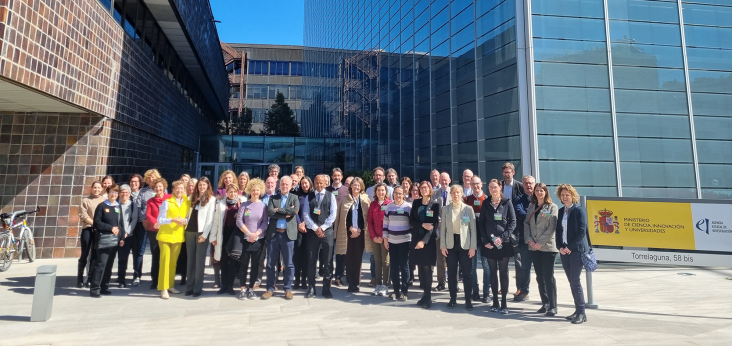
SYSTEMIC project partners Final Seminar
The SYSTEMIC final consortium meeting took place on the...
Final Seminar of SYSTEMIC project in Madrid
On 12 March, the coordinators and several partners of...
